Fix the required answer
Define the physical quantity, distinction or decision the measurement must support.
Measurement systems for consequential answers
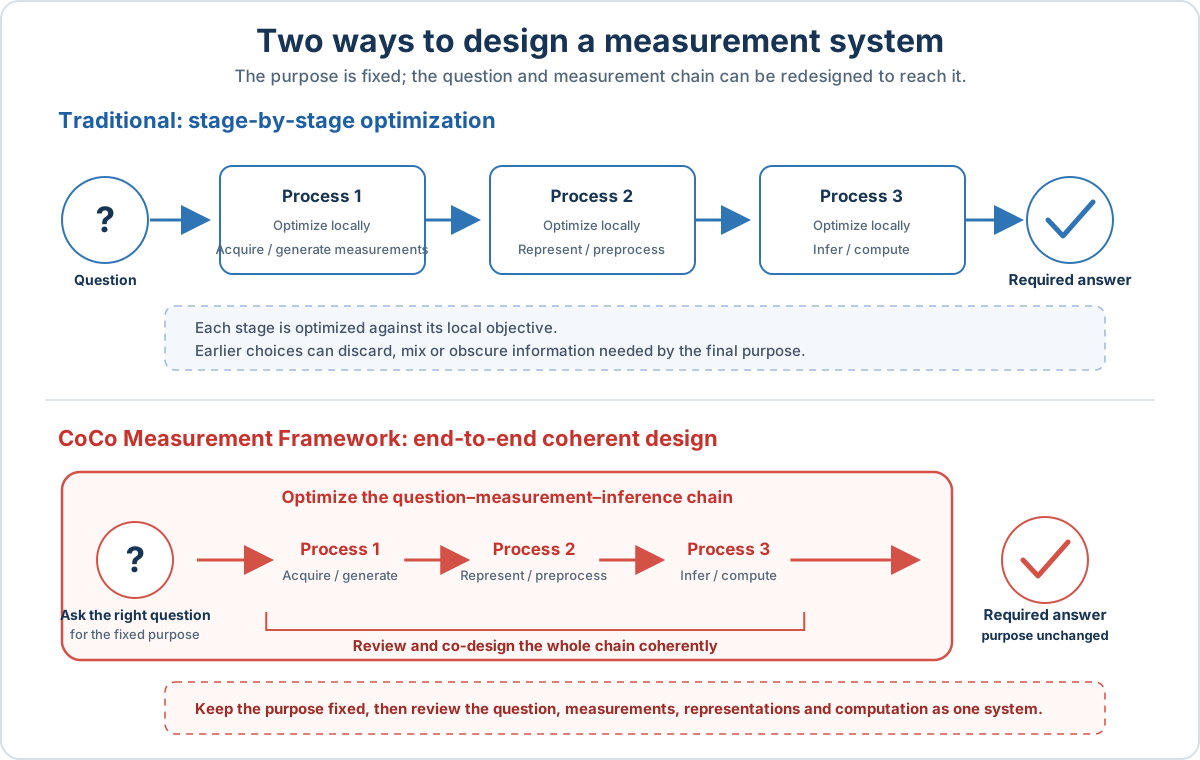
PJ Science ApS works on coherent measurement problems where useful physical structure is rejected, merged, averaged away or made impractical to recover. We start with the required answer and review the complete chain—from the question and physical experiment to acquisition, representation and inference.
The problem
Hardware, filtering, averaging, reconstruction and computation are often optimised as separate stages. The resulting system may answer what the instrument can conveniently produce rather than what the application actually needs to know.
Weak but useful returns can be rejected, physical constituents can be merged or misclassified, temporal structure can be averaged away, and richer coherent treatments can become impractical to compute.
Define the physical quantity, distinction or decision the measurement must support.
Locate where useful structure becomes weak, mixed, discarded or computationally inaccessible.
Compare against a credible baseline with a measurable threshold and a go, narrow, redirect or stop decision.
The approach
The CoCo Measurement Framework is PJ Science ApS’s working tool for jointly reviewing the question, physical experiment, measurement architecture, representation and inference needed to reach a defined answer.
The answer remains outside the optimisation boundary: the purpose of the measurement is not changed to suit the existing chain. The framework is not a universal product or a guarantee of improvement. Every application requires its own physics, baseline, evidence threshold and stop criteria.
Why the approach deserves attention
PJ Science separates physical, simulated and active-programme evidence. A result at one level does not automatically validate the next domain, application or commercial claim.
Working originating measurements include individual aerosol tracking, motion estimates along tracks and resolved high-rate velocity distributions.
Role: establishes the originating architecture and scientific proof source.
Clutter suppression and separation of two co-located moving objects with different radial velocities have been demonstrated within the tested configuration.
Role: shows that a material architectural principle transferred into RF hardware.
Repeatability, quantified operating limits, physical multipath, fair baseline comparison, independent review and representative application integration remain priorities.
Role: moves radar from demonstrated capability to decision-ready evidence.
Where the approach is intended to matter
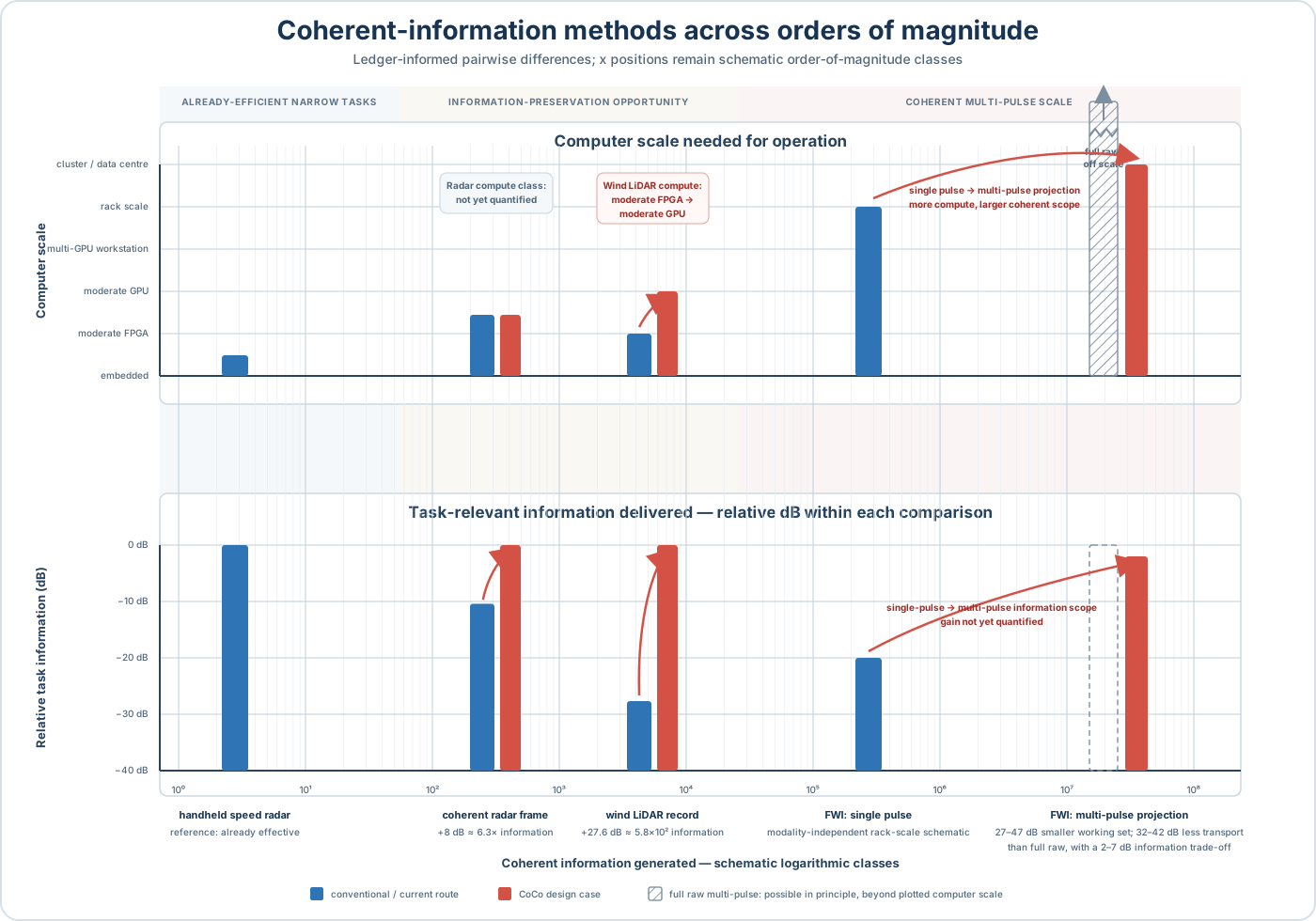
The CoCo Measurement Framework is not primarily intended to improve mature narrow-task instruments that already generate modest coherent information and use it effectively. It targets systems where preserving coherent structure or extending coherent scope changes the answer, but conventional approaches discard information or push computation beyond practical deployment.
A handheld speed radar performs a bounded task, generates comparatively little coherent information and already uses that information effectively.
More useful structure is physically available, but the current chain rejects, mixes or compresses it before the required inference.
The desired coherent scope exceeds practical full-raw computation, creating a need for purpose-designed representation or projection.
The red cases are selected design cases, not a smooth improvement curve or a claim that every modality benefits. LiDAR shows a large information-preservation change, radar a more modest one, and FWI a possible route from single-pulse processing toward tractable multi-pulse projection.
Technology programmes
Each programme has a different role in reducing technical and commercial uncertainty.
Origin and proof source
The originating architecture was built for a concrete wind-measurement problem and produced physical evidence of particle-resolved and high-rate motion information.
Current characterisation focus
Radar is the first demonstrated architectural transfer and the leading near-term candidate for bounded commercial validation, subject to repeatability, operating-envelope, baseline and application-fit evidence.
Third-domain transfer test
An active algorithm and hardware-validation programme intended to test whether the broader information-centred design discipline creates value in a bounded reconstruction problem.
Methodological frontier
Research into multi-pulse projection, experiment design and whether a defined inverse-problem decision can be made computationally tractable without claiming architectural transfer.
For collaborators
The best starting point is a problem where the required answer is clear, but the current measurement chain loses useful structure, creates ambiguity or makes the desired inference impractical. A collaboration begins with one bounded problem, one credible baseline and one representative validation environment.
PJ Science contributes a falsifiable experiment-design and inference proposal rather than requiring a partner to endorse the whole company thesis. Programme funding, evidence access, intellectual-property ownership, licence rights, exclusivity and parent-company equity remain separate decisions.
For investors
The investment case is not that PJ Science will become the product leader in every sensing field. It is that a shared measurement-design capability can create protected, field-specific technical assets, beginning with the LiDAR–radar core, while the company retains the reusable knowledge and evidence system.
Near-term capital is intended to move radar from demonstrated key capabilities to repeatable, quantitatively characterised and application-ready evidence—and to enable one informed commercialisation decision.